
Office Address
Berge du Lac, La Marsa |
Tunis, Tunisie
Phone Number
+216 95 038 819
Email Address
technologyelevator02@gmail.com
contact@technologyelevator.com
Berge du Lac, La Marsa |
Tunis, Tunisie
+216 95 038 819
technologyelevator02@gmail.com
contact@technologyelevator.com

 by Adel Adouni
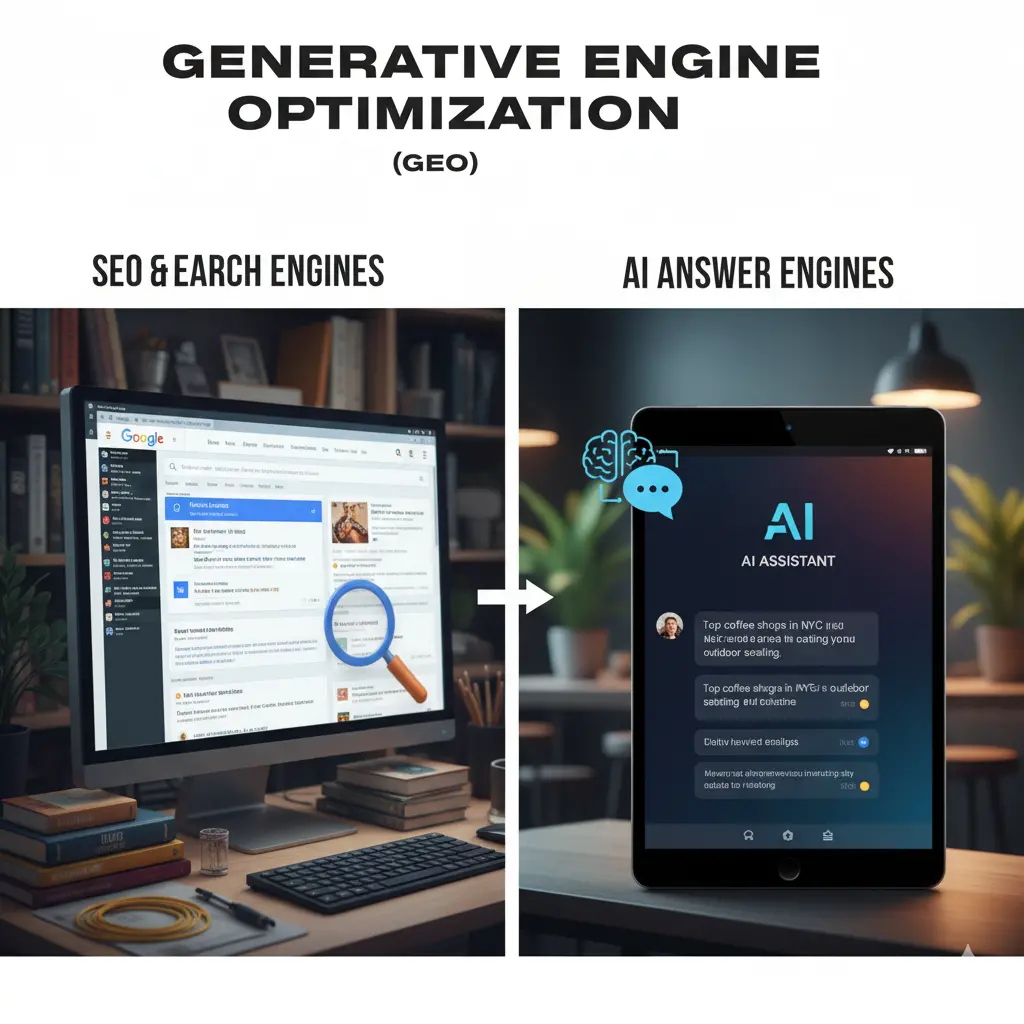
 Search as we know it is undergoing a massive transformation. For more than two decades, businesses focused on Search Engine Optimization (SEO) to win visibility on Google. But in 2026, a new shift has emerged users no longer rely solely on search engines. They increasingly depend on AI answer engines like ChatGPT, Google Gemini, Perplexity, Claude, and other conversational platforms to get instant, synthesized answers.
This shift has given rise to a new discipline:
GEO focuses on optimizing your content so AI-powered models can understand, retrieve, and use it accurately when generating answers.
If SEO helps you rank on Google, GEO helps you appear in AI-generated responses a powerful opportunity for visibility, authority, and organic growth.
This guide walks you step-by-step through what GEO is, why it matters, and how to implement it effectively in 2026.
Generative Engine Optimization is the process of optimizing your content for AI-driven answer engines instead of traditional search engines.
These engines don’t display “links” the same way Google does; instead, they:
GEO ensures your content is formatted in a way that makes it easy for AI models to interpret, index, and reference.
Users now ask AI tools directly for:
They expect a direct answer not 10 blue links.
If your content is not optimized for AI retrieval, you’re invisible in the fastest-growing search ecosystem.
Companies already report:
With Search Generative Experience (SGE), Google now displays AI-generated answers before organic results.
This means GEO is not optional it's the future of search visibility.
AI models rely on:
Example:
Content formatted as a list (“Top Benefits”, “Steps to…”) is more likely to be cited.
AI tools prefer immediate, concise answers followed by details.
Bad:
A long intro before providing the answer.
Good:
A direct 2–3 sentence answer at the top, followed by deeper explanation.
Use:
This helps AI understand relationships between concepts.
AI tools often answer natural-language prompts such as:
Embed conversational variations naturally within your content.
AI relies heavily on entities:
Example: mentioning “React, Angular, Vue, Django, Laravel, Kubernetes” makes your content more indexable.
AI models love FAQs because they match real user prompts.
Each article should have at least:
AI prefers structured workflows:
This increases your chance of being quoted.
AI models rank sources higher when they sense:
Publishing multiple articles within the same cluster improves visibility.
| Feature | SEO | GEO |
|---|---|---|
| Focus | Google rankings | AI-generated answers |
| Keyword style | Exact match | Conversational & semantic |
| Structure | Optimized for crawlers | Optimized for AI understanding |
| Output | List of links | Final synthesized answer |
| Ranking factor | Backlinks | Content clarity & authority |
Both are important but GEO is becoming essential for AI-era search visibility.
Group your content:
This gives AI a complete knowledge base.
Add:
This helps AI engines read your website structure accurately.
Follow this pattern:
The clearer the structure → the stronger the AI indexing.
AI engines prefer content with:
AI systems penalize vague or unverified claims.
Include:
Generative Engine Optimization is not a trend it is the new foundation of digital visibility. As AI-driven answer engines grow, businesses must adapt their content to be discoverable, readable, and reference-worthy for models like ChatGPT, Claude, Gemini, and Perplexity.
The earlier you adopt GEO, the more competitive advantage you gain.